
Criminal Court Records in Greene County
A criminal court record is the case file the court keeps once a criminal charge is formally before the court. In Greene County the Circuit Clerk holds the felony case files. The file gathers every official document tied to one defendant and one set of charges. That includes the charging paper, court appearances, plea petitions, appointed-counsel petitions, motions, hearing notices, orders, the disposition, the sentence, and any later financial obligations. Cecelia Bounds serves as Greene County Circuit Clerk, and her office maintains the circuit criminal docket, fines, and judgment rolls at the courthouse in Leakesville.
Greene County sits in Mississippi's split trial-court system, so more than one court touches a criminal case. Circuit Court tries felony cases after indictment and hears misdemeanors brought up on appeal. Justice Court handles the first steps of a felony, along with misdemeanors, county ordinance violations, and traffic matters. The charges themselves are detailed in the Greene County court charge records, while the wider set of civil, family, and land files appears across all court records. Youth Court handles juvenile matters, and those files are confidential rather than public.
How Felony Cases Reach Greene County Circuit Court
Mississippi felony cases do not start in Circuit Court. A felony arrestee has no Circuit Court file until a grand jury returns an indictment. The first court step is Justice Court, where the case is heard for an initial appearance and the filing of an affidavit. Justice Court judges hold sessions at the jail three times each week so that an arrestee receives an initial appearance within three days of arrest. At that stage the record lives with Justice Court and the arresting agency, not with the Circuit Clerk.
The District Attorney for Mississippi's 19th Judicial District prosecutes felonies for Greene County, along with Jackson and George Counties. The office presents felony cases to the grand jury and prosecutes the indicted cases in Circuit Court. Angel Myers McIlrath is the District Attorney, and the office is reachable at P.O. Box 1756, Pascagoula, MS 39568, phone 228-769-3045. The role of the office is laid out on the 19th Judicial District Attorney page.
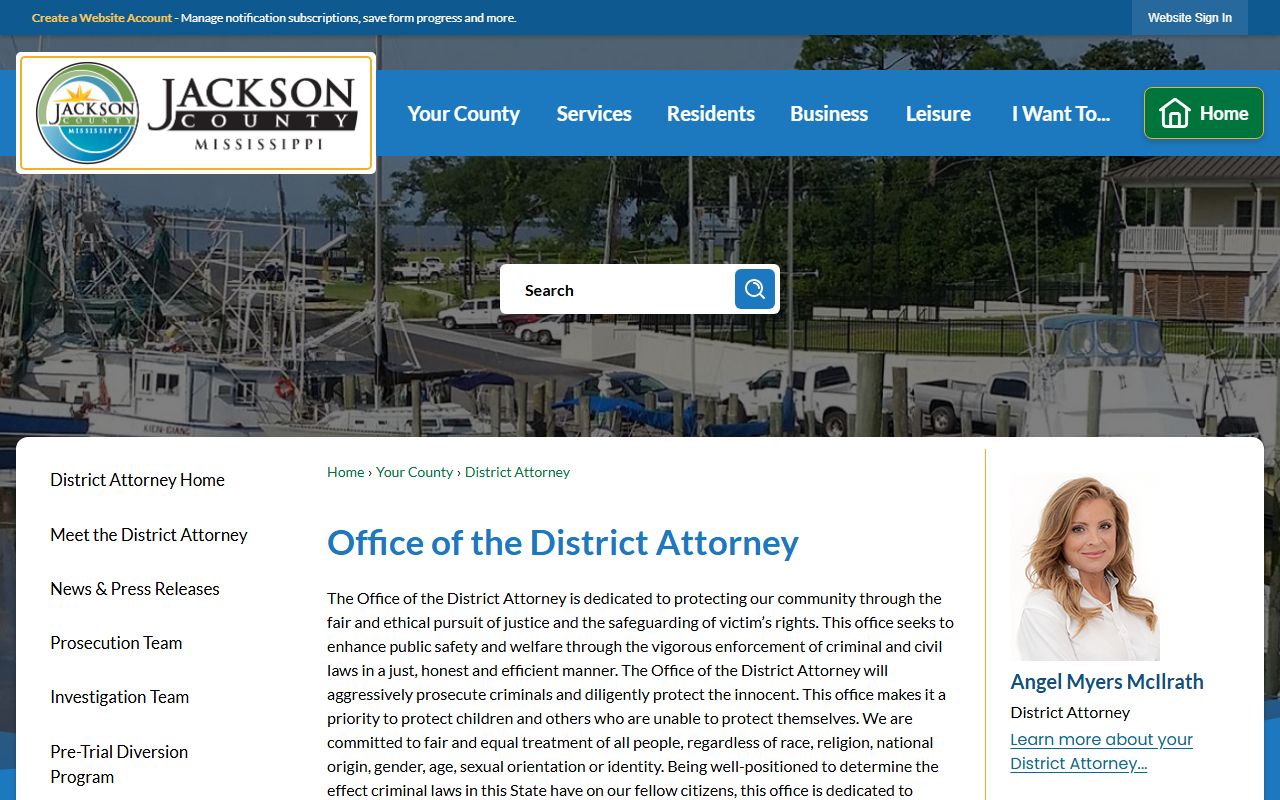
That office reports roughly 2,500 to 3,500 criminal cases a year across the three-county district. The District Attorney also receives notice in some expungement matters under Mississippi law.
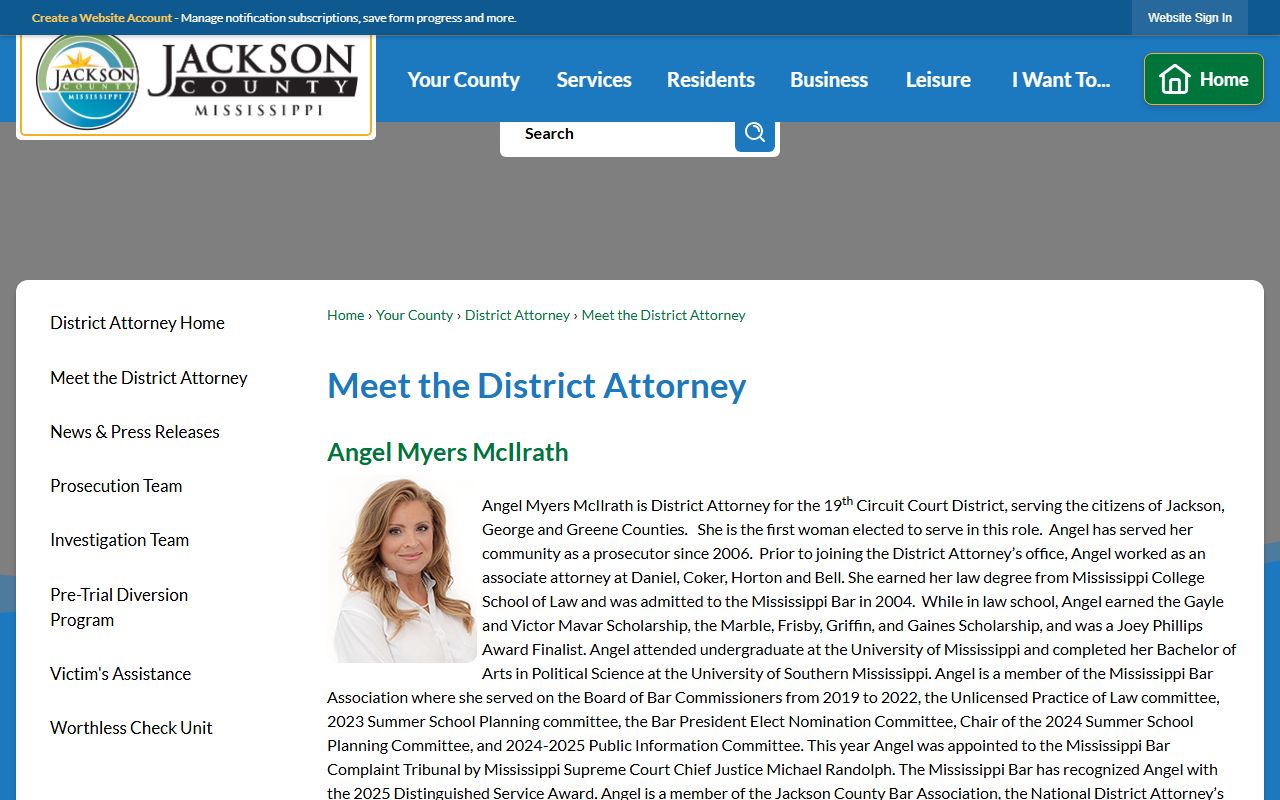
Background on the elected prosecutor sits on the District Attorney biography page, which notes she has served as a prosecutor since 2006 and is the first woman elected to the post.
Once a grand jury indicts, the case becomes a Circuit Court file, and the defendant, a bonding agent, or the public can locate the case and the next court date through the state system. Grand-jury dockets themselves are never open to the public.
Stages of a Greene County Criminal Case
A criminal case moves in steps, and each step leaves its own mark in the file. Reading a record is easier when the order of those steps is clear. The flow below covers a felony from the moment charges enter court through the final sentence.
Case flow: Arrest / Booking › Justice Court Initial Appearance › Grand Jury Indictment › Arraignment › Pretrial / Motions › Plea or Trial › Disposition › Sentencing
| Stage | What Happens |
|---|---|
| Initial Appearance | Justice Court advises the arrestee of the charges, rights, and possible bond within three days of arrest. |
| Indictment | A grand jury reviews the felony charge and returns an indictment that opens the Circuit Court file. |
| Arraignment | The defendant is formally read the charges in Circuit Court and enters a plea of guilty or not guilty. |
| Pretrial / Motions | Lawyers file motions, exchange evidence, and argue legal issues before any trial. |
| Plea or Trial | The case ends in a plea or goes to a jury, where a unanimous vote of 12 is required to convict. |
| Sentencing | After a guilty plea or verdict, the judge imposes the sentence and any fines or supervision. |
Note: A Greene County felony case may show months of gaps because Circuit Court terms are held quarterly in February, May, August, and November.
How to Search Greene County Criminal Court Records
Circuit Court is the strongest online path for Greene County criminal records. The Circuit Clerk states that Greene County Circuit Court takes part in Mississippi Electronic Courts. All criminal and civil cases from 2008 to the present, and judgment enrollments from 2005 forward, are available online through the system by choosing Greene Circuit from the court list.
- Open the Mississippi Electronic Courts portal and choose Greene Circuit from the court list, as the Circuit Clerk directs.
- Log in with a PAMEC account to view docket information and case documents. A MEC filer account is only for filing.
- Search by the defendant name or, where known, the case number after login.
- Open the case to read the docket report, the judge assignment, the status, and the next court date.
- Request a certified copy from the Circuit Clerk if the file is needed for a legal purpose.
Access through Public Access Mississippi Electronic Courts carries a charge of $0.20 per page returned by a search, and a no-match search is still billed for one page. If a document is not online, if access is restricted, or if the case predates the online coverage, the Circuit Clerk can be reached at 601-394-2379, or a written public-records request can be mailed to P.O. Box 310, Leakesville, MS 39451. The office answers or refers a request within seven days of receipt.
What a Greene County Criminal Court Record Shows
A Greene County criminal file is built from documents filed as the case moves. The public pre-login pages do not display a sample case screen, but local sources identify the parts a reader should look for. A docket report shows the assigned judge and the filing activity, and the file may carry the indictment, plea petition, motions, hearings, bond or fine information, the disposition, and the sentence. The fields below appear across most criminal case files.
| Field | What It Shows |
|---|---|
| Case Number | The court's identifier for the file; format is not published locally, so a name and filing date are reliable anchors. |
| Defendant | The person charged, listed in criminal cases as the State against the defendant. |
| Charges | The offenses in the indictment, including the statute and severity level. |
| Plea | The defendant's formal response, such as guilty or not guilty. |
| Disposition | The outcome of each charge, such as dismissal, plea, conviction, or acquittal. |
| Sentence | The punishment or terms imposed after a conviction, plus any fines or supervision. |
Some items are kept out of public filings by rule. The court's electronic procedures warn that Social Security numbers, dates of birth, the names of minor children, financial account numbers, and home addresses may not appear in a filing except as the rules allow.
Charges vs. Convictions in Greene County
A charge is an accusation, and a conviction is a final finding of guilt. The two are not the same, and a criminal court record can show charges that were dropped, dismissed, reduced, or that ended in acquittal. Reading the disposition for each charge is the only way to know how a case actually ended. A file that lists serious charges may still close with no conviction at all.
| Charge | Conviction | |
|---|---|---|
| Stage | Accusation by indictment | Verdict or accepted plea |
| Burden of Proof | Probable cause | Beyond a reasonable doubt |
| Decided By | Grand jury or prosecutor | Trial jury, judge, or guilty plea |
| Public Record | Yes | Yes |
Because both charges and convictions are public, a record search can surface an arrest charge that was later dropped. That is one reason a casual lookup is a poor substitute for a regulated background check.
Reading Dispositions and Sentences
The disposition is the outcome line for a charge, and the sentence is what follows a conviction. A few terms recur across Greene County criminal files and are worth defining before reading one.
- Disposition
- The outcome of a case or a single charge, such as dismissal, plea, or conviction.
- Non-adjudication
- A Mississippi disposition that may avoid a conviction if the defendant completes set conditions.
- Sentence
- The punishment or terms imposed after a conviction, including jail, fines, or probation.
- Probation
- Court-ordered supervision served instead of, or after, time in custody.
A sentence in the file may pair a term of custody with a fine, restitution, and supervision. Greene County criminal files can also carry post-conviction financial obligations, and mailed fine payments must use a money order with the offender name and case number. The full filing history that leads to a disposition sits in the case docket the clerk keeps for that file.
Sealed vs. Expunged Records
Sealing hides a record from ordinary view, while expungement removes an eligible record from public access and treats it as though it never existed. The Greene County public-records form lists expunged files as records that are never open to the public. An expungement usually begins in the court where the case or conviction occurred, so a Circuit Court conviction is handled through the Circuit Clerk and Circuit Court.
| Sealed | Expunged | |
|---|---|---|
| Visibility | Hidden from public view | Removed from ordinary public access |
| Law Enforcement | Limited access kept | State may retain nonpublic data for first-offender status |
| How It Starts | Court order, often youth or sensitive cases | Petition filed in the court of conviction or case |
| Eligibility | Set by statute and case type | Eligible misdemeanors, some felonies, and dismissed or no-disposition arrests |
The local fee schedule lists $146.00 for an expungement petition under non-adjudication statutes Miss. Code Ann. § 99-15-26 or § 41-29-150, and $296.00 for a petition under § 99-19-71. Not every offense qualifies. Excluded felony categories include violent crimes, first-degree arson, trafficking, later DUI offenses, and felon in possession, among others. Mississippi law requires notice to the District Attorney before some hearings, and the court may weigh rehabilitation and statutory eligibility.
Statewide Criminal History Records
A Circuit Court file covers one county and one case. A statewide criminal history pulls records together across Mississippi and is kept by the Department of Public Safety. The Criminal Information Center is the state repository for criminal-history data, and it is the channel for a record that reaches beyond Greene County. The center's role is described on the DPS Criminal Information Center page.

The state repository draws from arresting agencies and courts statewide, so it can show charges and dispositions that a single county docket does not. A statewide history request usually calls for a signed release.
That release sets the terms for a background check and gathers the subject's identifying details. The form is reached through the DPS background-check authorization page.
After an expungement, the state may still retain nonpublic information to determine a later first-offender status, so a cleared court file does not always mean every state record is gone.
Note: A recent Greene County arrest may not appear in a statewide history right away because court and agency data take time to reach the state repository.
Public Defense in Greene County Criminal Cases
A defendant who cannot afford a lawyer may receive appointed counsel, and the appointed-counsel petition appears in the case file. For felony-level public defense, the Mississippi Office of State Public Defender directory lists Chris Dobbins as the Greene County felony public defender, P.O. Box 794, Leakesville, MS 39451, phone 601-394-2112. Because assignments can be case-specific, the court handling a case is the place to confirm which public defender or appointed-counsel process applies.
The state office keeps a public lookup for matching a county to its defender. The tool is on the find a public defender page.
The Greene County Youth Court page separately lists Chris Dobbins as county prosecutor and Elliot Burch as Youth Court public defender, so a juvenile matter routes through different counsel than an adult felony.
Public Access to Criminal Court Records
Mississippi policy favors public inspection of records unless another law makes them confidential. Criminal case files in Circuit Court are public once a case is open, subject to redaction and any sealing order. The consolidated text of the state's open-records law is published by the Mississippi Ethics Commission, and the key sections are short.
Key Statutes:
Miss. Code Ann. § 25-61-5 - Any person may inspect and copy public records under reasonable written procedures, and a denial must be written and specific.
Miss. Code Ann. § 25-61-12 - Incident reports are public, but law-enforcement investigative reports and certain victim and personnel details may be exempt.
When a file is not online, the written public-records request to the Circuit Clerk is the fallback. The clerk's form lists fees of $1.00 per page for copies, $10 per hour for clerical help, and $40 per hour for technical or professional help. Records tied to expunged files, grand-jury dockets, personal identifying information, or juvenile matters may be restricted, redacted, or unavailable.
Background Check Considerations
A court-record lookup and a regulated background check are different things. A casual search can show a charge without making clear whether it ended in a conviction, and it may miss records held in another county or by the state. A formal background check, run for employment or tenant screening, follows federal rules and uses verified sources. Anyone making a decision covered by those rules should rely on a compliant report, not a quick name search.
Important: Greene County Court Records is not a consumer reporting agency under the Fair Credit Reporting Act, and its data may not be used for credit, employment, tenant, or insurance decisions.
Restricted Greene County Criminal Court Records
Not every criminal-related record is open. Some are sealed by law, some are held by another office, and some are withheld while a matter is active. Knowing which files fall outside ordinary public access saves a wasted request.
- Youth Court and juvenile records are confidential and are not ordinary public court records.
- Grand-jury dockets are listed on the public-records form as never open to the public.
- Expunged files are removed from ordinary public access by court order.
- Personal identifying information is redacted from filings under court rules.
- Law-enforcement investigative reports may be exempt even when an incident report is public.
For custody status tied to a criminal case, the Greene County inmate records page covers the jail and state-custody channels, and active orders for arrest are covered on the warrant records page. When a file is sealed or restricted, the holding office can confirm whether any portion is releasable.