
Greene County Arrest Records and Court Charges
An arrest record is the account of the arrest itself. It notes who made the arrest, the date and time, the agency involved, and the booking that follows. In Greene County the arresting agency is usually the Sheriff's Office under Sheriff Ryan Walley, a city police department, or the Mississippi Highway Patrol. Booking detail such as the booking number, the charges listed at intake, and any bond sits on the custody side of the process. The county does not publish an online jail roster, so current local custody and booking questions go to the Sheriff's Office at 601-394-2341 or 601-394-2342.
The court charge record is a different thing. Once a person is arrested, the prosecutor reviews the case and files formal charges with the court, and those charges become the charge record. Booking and jail-roster detail belongs to the custody side, so the Greene County inmate records page is the place to start for who is held and on what booking charges. The court charges after arrest, along with the full case file and outcome, are tracked through the criminal case as it moves through the courts.
How to Find Greene County Arrest Records and Charges
Court charges and their status show up in the court case file, not in a booking blotter. For felony cases that reach Circuit Court, that file is searchable through Mississippi Electronic Courts. Fresh arrest and booking detail lives with the Sheriff's Office and the jail, and early misdemeanor or initial-appearance charges run through Justice Court. The steps below move from the online case index to the offices that hold what is not posted.
- Open the Greene Circuit case search through the Mississippi Electronic Courts portal and register for a public PAMEC login if you do not have one.
- Search by the defendant name or, if you have it, the case number.
- Open the case and read the list of charges filed against the defendant.
- Check each charge for its statute code, its level, and its current status.
Many recent arrests will not appear in the circuit index yet, because a felony has no Circuit Court file until the grand jury acts. For those, call the Sheriff's Office for custody status, call Justice Court at 601-394-2347 for initial-appearance and affidavit matters, and use the statewide criminal-history channels covered further down for a broader record.
How Charges Get Filed After a Greene County Arrest
The arrest happens at booking, but the charge record really begins when a prosecutor files a charging document with the court. The document names the offense, ties it to a statute, and starts the formal case. Three main types exist, and which one is used depends on how serious the offense is and which court hears it.
| Complaint / Affidavit | Information | Indictment | |
|---|---|---|---|
| Filed By | Officer or prosecutor, by sworn affidavit | Prosecutor | Grand jury |
| Common For | Misdemeanors and initial felony filings | Some felonies by prosecutor | Felony cases in Greene County |
| Starts | The lower-court case | A felony case | The Circuit Court case |
In Greene County most felony cases proceed by indictment rather than by a prosecutor's information. The charge a person is booked on at arrest can change once the prosecutor and the grand jury review the file, so the booking charge and the charge that is finally filed are not always the same.
From Arrest to Indictment in Greene County
Greene County follows a clear path from arrest to a formal charge record. A felony case is first heard in Justice Court for the initial appearance and the affidavit filing. The local judges hold jail sessions three times each week so that a person gets an initial appearance within three days of arrest. Bond and the early charges may be addressed there.
The case becomes a Circuit Court record only after the grand jury acts. The District Attorney for the 19th Judicial District, Angel Myers McIlrath, presents felony cases to the grand jury for Jackson, George, and Greene Counties. If the grand jury returns an indictment, a Circuit Court file opens and the charges become the public criminal case file. The flow runs like this: arrest and booking, then Justice Court initial appearance and affidavit, then grand-jury review, then indictment, then the Circuit Court file. The full case file, pleas, and sentence are covered on the criminal court records page.
Charge Status and What It Means
Charges are not fixed once they are filed. As a case moves, a charge can be amended, reduced to a lesser offense, dropped, or dismissed. Reading the status next to each charge tells you where that count stands right now. The terms below are the ones that turn up most often on a Greene County case file.
| Status | What It Means |
|---|---|
| Pending | The charge is filed and the case is still open and moving through the court. |
| Amended / Reduced | The charge was changed, often to a lesser offense or a corrected statute. |
| Dropped | The prosecutor chose not to pursue that count before it was resolved. |
| Dismissed | The court ended the charge without a conviction on that count. |
| Nolle Prosequi | The prosecutor formally declined to prosecute the charge. |
A single case can show several of these at once. One count may be pending while another is dismissed and a third is reduced under a plea agreement.
Greene County Charge Codes and Severity Levels
Each charge is tied to a section of the Mississippi Code, and that statute sets the level. Felonies are the most serious and are the cases that reach Circuit Court in Greene County. Misdemeanors are lower-level offenses handled in Justice Court or Municipal Court, and minor infractions sit below those. The level drives where the case is heard, how it is charged, and what penalty range applies.
One arrest can produce several separate charges. A person booked after a single incident might face one felony count, a misdemeanor count, and a traffic or ordinance count, each with its own statute code and its own status. Reading the code next to each charge is how you tell a serious felony count from a minor companion charge on the same case.
Greene County Charges vs. Convictions
Being charged is not the same as being convicted. A charge is an accusation that the case has yet to prove. A conviction is the result reached by a plea or a verdict. Many charges are later dropped, reduced, or dismissed, so a charge on its own says nothing final about guilt.
| Charge | Conviction | |
|---|---|---|
| Stage | Accusation at filing | Verdict or guilty plea |
| Burden of Proof | Probable cause | Beyond a reasonable doubt |
| Public Record | Yes, in the case file | Yes, in the disposition |
| Final? | No, it can still change | Yes, unless appealed |
Note: A dismissed or dropped charge still appears in the case file unless the record is later expunged by court order.
Sealed and Expunged Greene County Charges
Some charge records are closed to the public. A sealed record is hidden from ordinary public view but may still be reached by limited official access. An expunged record is treated as though it never existed for most purposes, and the Greene County public-records request form lists expunged files as records never open to public access. The two terms are easy to confuse, so the definitions below keep them apart.
- Sealed
- The record is removed from public search but can still be seen by certain courts and agencies under limited conditions.
- Expunged
- The eligible record is cleared from public access by court order and should not show up as an ordinary searchable case.
- Eligible charges
- Certain first-offender misdemeanors, selected felonies after waiting and payment requirements, and arrests ending in dismissal, not guilty, or no disposition may qualify by petition under Mississippi law.
An expungement begins in the court where the case happened, which for a felony means the Circuit Court and Circuit Clerk. The local fee schedule lists $146.00 for petitions filed under the non-adjudication statutes and $296.00 for petitions under Miss. Code Ann. § 99-19-71. Violent crimes and several other categories are excluded, so not every charge can be cleared.
Statewide Charge and Criminal History Lookups
Charges filed in Greene County roll up into a statewide criminal-history repository kept by the Mississippi Department of Public Safety. The DPS Criminal Information Center handles name-based background checks. A request uses the DPS authorization form, a $32 money order, and a copy of a state ID or driver license, and the result can take up to 30 days. This is the official route for a broad criminal-history check rather than a single county case lookup.
A separate free public search covers convicted sex offenders. The state keeps registrants on its public registry, searchable through the Mississippi sex-offender registry.
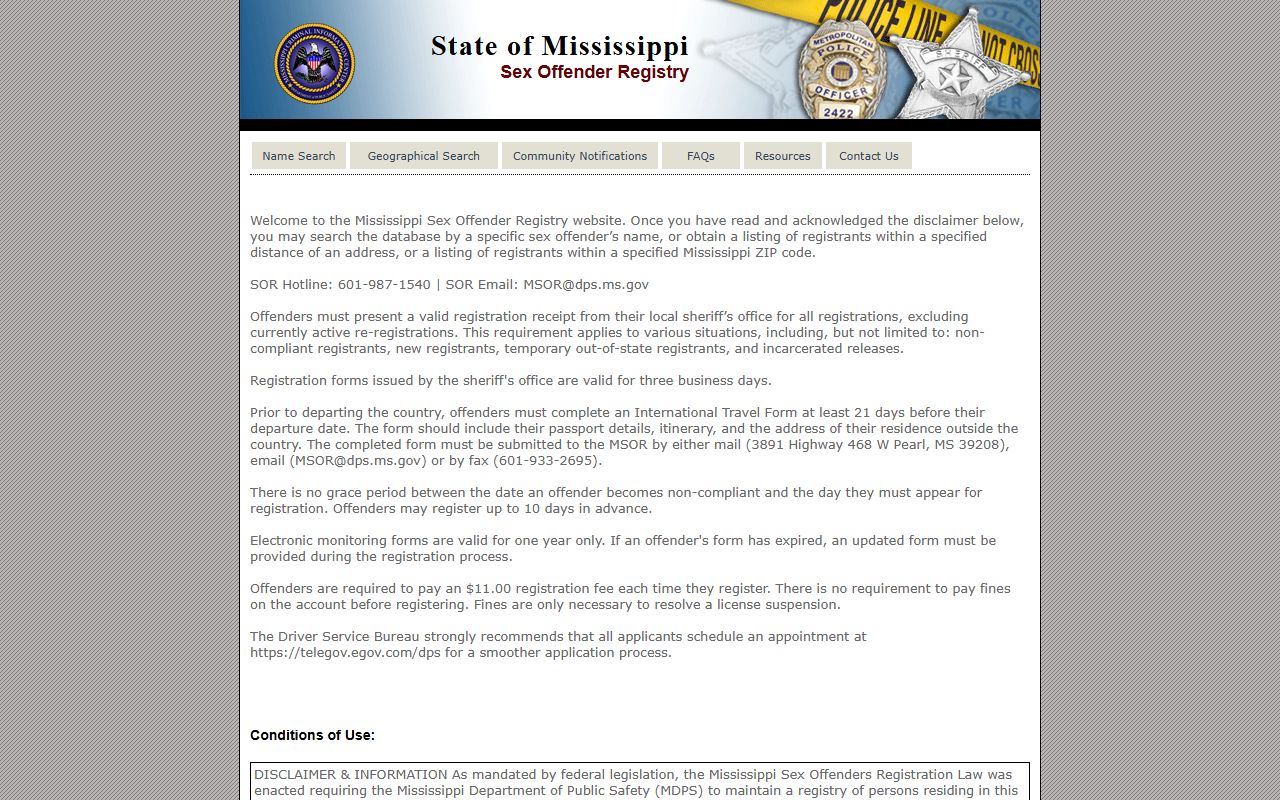
The registry lists people convicted and required to register, so it is not a substitute for a full Greene County arrest records check or a current charge lookup.
Most Wanted and Crime Stoppers Resources
When a charge ties to an open fugitive case, two statewide tools can help. The state compiles a fugitive list that any resident can view, drawn from agencies across Mississippi. The list appears on the Mississippi DPS Most Wanted page.

The Most Wanted page is a statewide resource and is not a complete Greene County warrant or arrest search, so it works best as one channel among several.
Tips on a wanted person or an unsolved case go through a statewide tip line. The program and its number sit on the Mississippi DPS Crime Stoppers page, reachable at 1-888-827-4637, also written 1-888-8CRIMES.
Crime Stoppers takes anonymous tips, which is a different function from looking up the charges already filed in a court case.
Federal Charges Involving Greene County
Not every charge after a Greene County arrest stays in the county courts. Federal offenses are charged and prosecuted in the U.S. District Court for the Southern District of Mississippi, with the county placed in the Southern Division at Gulfport. Those cases are handled by the U.S. Attorney's Office for the Southern District of Mississippi.
Federal charges do not appear in the Greene County Circuit or Chancery systems, and their records run through the federal PACER system instead.
Local examples do surface in federal releases. The office published a case involving a Leakesville man who pleaded guilty to a firearm-purchase charge, which shows how a Greene County matter can become a federal charge.
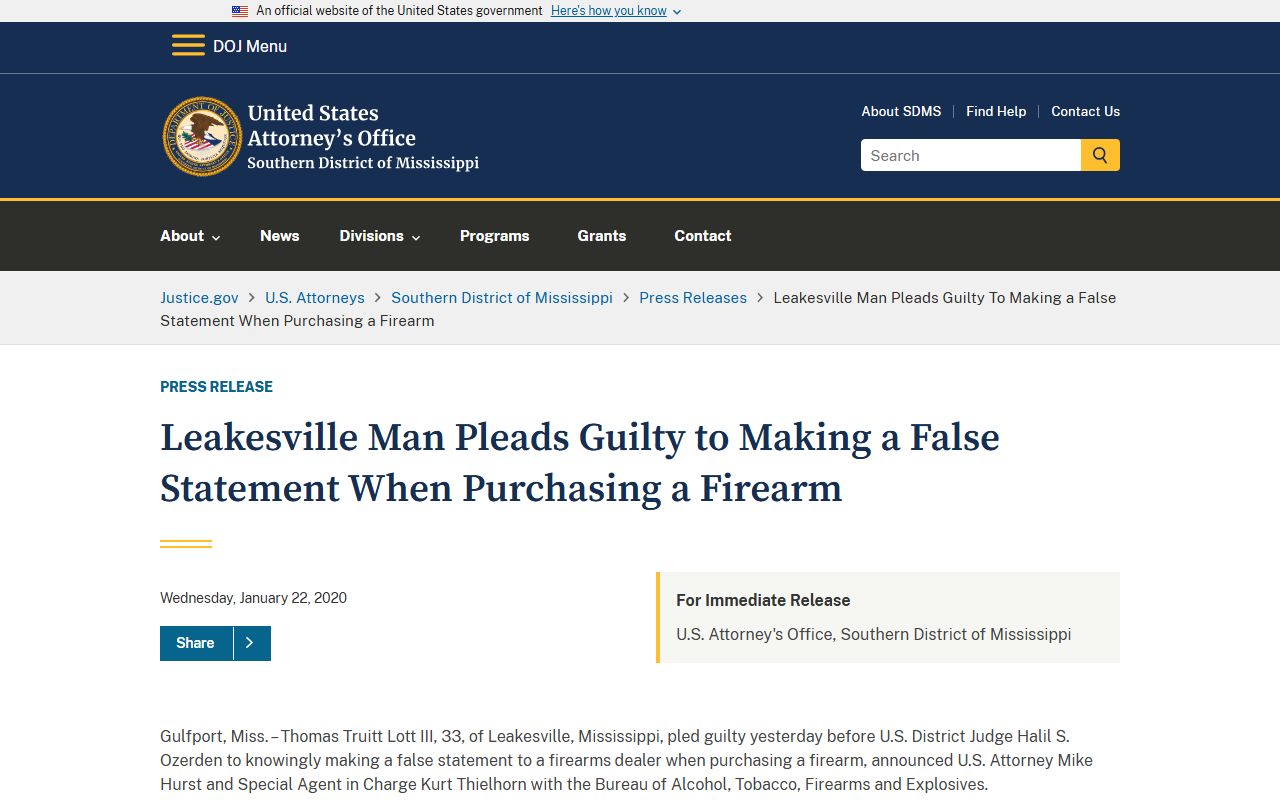
A release like this confirms the charge and the plea, but the full federal docket and any sentence are found through PACER rather than the county clerk.
Background Check Considerations
A casual charge lookup is not the same as a formal background check. A formal check that affects credit, a job, housing, or insurance must follow the Fair Credit Reporting Act and run through a regulated consumer reporting agency. The official state route for a name-based criminal history is the DPS Criminal Information Center described above, and a Greene County case file is read directly through the court index.
Important: Greene County Court Records is not an FCRA-regulated consumer reporting agency, and nothing here may be used to decide credit, employment, housing, or insurance.
Restricted Charge Records in Greene County
Some charge records are kept out of public access by law. Youth Court handles juvenile matters in Greene County, and those records are confidential under Miss. Code Ann. § 43-21-251, so a juvenile charge should never be treated as an ordinary public case. Grand-jury dockets are listed on the county public-records form as never open to public access, which matters because Greene County felonies move through the grand jury.
Expunged files are also closed once a court orders the clearing, and law-enforcement investigative reports may be withheld even when the basic incident report is public. A dismissed or dropped charge can still sit in the case file until it is expunged. When a record cannot be found online, the written public-records request to the holding office is the fallback, and that office answers or refers a request within seven days.